
Think generative AI is the top business tech story of the early 21st century? Not so fast. Sure, large language models like ChatGPT are poised to change the way we work—particularly how we communicate at work. But don’t overlook the way machines communicate with each other, with or without an AI component.
You’ve heard of this developing paradigm. It’s called the Internet of Things (IoT), and it depends on a few technologies to make life easier at home and in the workplace. Maybe you’re aware of what IoT can bring to your operation: Bigger data, deeper insights, more automation, predictive everything, from analytics to asset maintenance. Or maybe you’re ready to add IoT capabilities to existing product lines. Either way, you have to start somewhere. Start here.
To begin, here are the basic elements of an IoT system:
- Networks (how data moves from one machine to another)
- Software (how we interact with our IoT systems; also, on the back-end, how these systems handle data)
- Devices (hardware that collects, shares, and sometimes even processes data)
This series of four articles will cover IoT devices in particular. However, we’ll discuss all the parts of an IoT ecosystem as we go. An IoT device is only meaningful for what it can do, after all. That functionality depends on the whole system. But the best way to understand IoT is through the point of data collection, and that’s the device.
“An IoT device is only meaningful for what it can do, after all. That functionality depends on the whole system.”
-Very Technology
In other words, you can’t have an Internet of Things without things. Keep reading for an executive introduction to IoT devices: What they are, how they work, and why they’re important for today’s enterprises, no matter the mission. We’ll start with the obvious question: What is an IoT device?
What Is An IoT Device?: A Concise Definition and a Few Examples
An IoT device is a physical object that sends and/or receives data over a network. It really is that simple—until you look a little closer, that is. Every operational challenge needs a different IoT device, and IoT solves a lot of challenges.
For example:
- Manufacturing equipment uses sensors to detect anomalies within its own processes. That leads to predictive maintenance, reduced surprise downtime, and higher productivity overall.
- Connected parcel lockers end delivery theft, giving homeowners secure, reliable access to their online purchases through easy-to-use apps.
- Remote asset-tracking systems tell you where shipments are. They can even tell you how shipments are doing. This IoT condition monitoring can create a safer cold chain, for instance, by sending temperature readings for everything from frozen pizzas to life-saving vaccines.
These examples barely scratch the surface of IoT functionality, but hopefully they hint at the variety of solutions currently in the market. They also demonstrate an important point: IoT devices aren’t just ready-to-ship products. They’re also connected sensors that the right IoT partner can help you integrate into existing product lines, manufacturing assets, and more.
In other words, IoT devices fall into a few different categories. We’ll look at those next.
The Three Main Applications of IoT Devices
It’s helpful to divide the world of IoT applications into three broad classes:
- There’s consumer IoT, including devices like smart watches, smart home products, and even virtual assistants. These are ready-to-use products that connect to a broader IoT network. Consumers buy them; hence the name.
- Then there’s commercial IoT. These are business tools. You’re most likely to encounter them outside the home, at a shop, office building, entertainment venue, or other commercial space. These connected devices may process payments on the go. They might control a skyscraper’s HVAC system. They might even monitor heartbeats or blood sugar levels, as in the subset of healthcare IoT.
- Finally, you have the world of Industry 4.0: Industrial IoT. These devices include sensors that connect to the internet to monitor equipment or automate data sharing. Manufacturers and supply chain operators use these devices. They track assets, they conduct predictive maintenance, they monitor conditions. But they usually aren’t packaged up and sold to the public.
This is your classic B2C vs. B2B market division: Consumer IoT is part of our day-to-day lives. Commercial and industrial IoT are part of specialized industries. Regardless of the use case, however, all IoT devices follow the same general procedure to deliver results. Let’s take a closer look at that process.
How IoT Devices Work
By definition, IoT devices are connected to one another. They might be connected to a central data warehouse. Or they might be connected to the enterprise software you use to turn information into business insight. Whatever they’re connected to, IoT devices are connected.
Here’s how these devices use those connections to make your life easier:
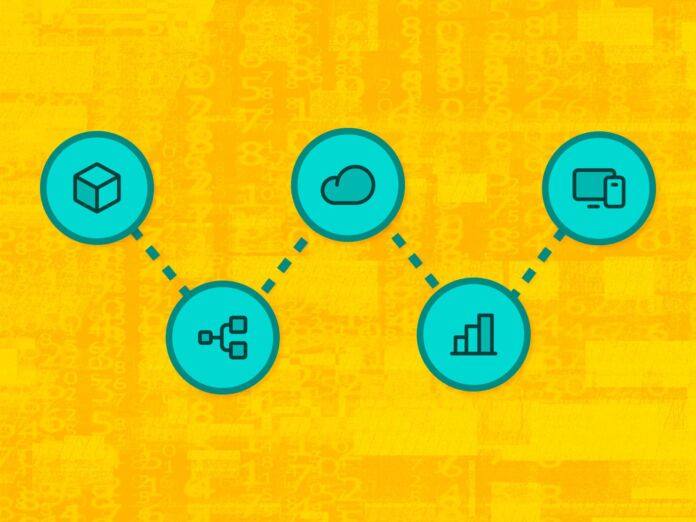
- The IoT device collects data. That could be a temperature reading. It could be a security snapshot. It could be an exact location. To the machine, it’s all data.
- The device transmits that data over a network. Any and all network technologies can be used for IoT: WiFi, Bluetooth, satellite, cellular, even hard-wired ethernet connections. The IoT device is connected to a network, which it uses to send and receive data. So where does that data go?
- Data arrives at a storage center. An IoT data warehouse may be on a server miles away from the device, in the cloud. Or the system may centralize data on a nearby device. We call that the edge. Some devices collect, store, and even process data on the edge.
- Software processes data and may send an instruction to the device. Software in the cloud or at the edge uses data to do something. It might send an instruction to adjust an HVAC setting, for instance. It might turn on or off a light. Maybe it sends a push notification to a human user, as in predictive maintenance scenarios. Or it might simply organize data for the final step in the IoT process.
- An IoT platform makes insight available to users. The true strength of IoT is its ability to collect huge data sets. That gives us the business insight we can use to make stronger decisions every time. But to put that information to use, you need an intuitive user interface within a well-designed app.
To recap, what is an IoT device? It’s network-connected hardware. But that doesn’t answer the more important question: What can IoT devices do for you? For any IoT project, start by clearly identifying your goals.
- Are you building a consumer IoT device?
- Or do you need IoT to solve a key business challenge?
- If so, what’s that challenge—more business intelligence, better equipment uptime, reducing asset loss, personalized marketing?
IoT devices can do all these things and more. But they can’t provide an answer until you ask the right question.
Once you define your business case, of course, another challenge awaits: How will you manage massive IoT deployments, which may consist of tens of thousands of devices in the field? Find out in Part 2 of our series on IoT devices, which will focus on developing strong IoT device management systems.
Tweet
Share
Share
- Device Management
- Cloud Software
- Data Analytics
- Internet of Things
- IoT Platforms
- Device Management
- Cloud Software
- Data Analytics
- Internet of Things
- IoT Platforms