
Once, long ago, a creature not quite human walked the Earth. She was tiny in stature, the size of a child, with a much smaller brain. She probably communicated with grunts, hoots, and laughs, like chimps, but didn’t speak. And that’s why she didn’t have a name, at least not one we’d think was a name, today.
Upon discovering her bones in what is now Ethiopia, scientists gave her a name: Lucy. She was the first Australopithicus afarensis ever found, a hominin predecessor to people today. It’s not known if A. afarensis was our direct precursor or an offshoot from a common ancestor. But either way, her fossil—together with hundreds of others found later—gives hints about the origins of our own species, a chapter of our ancient past difficult for us to otherwise unearth.
Three million years after Lucy died—possibly after falling from a tree—a NASA spacecraft that launched in October 2021 has traveled more than a hundred million kilometers from Earth on its way to Jupiter’s realm. The spacecraft’s body itself is small in stature, only about the height of an adult human, but its mission is a grand one: to explore two clusters of asteroids entrained by Jupiter’s gravity, relics untouched since the dawn of the solar system.
Billions of years ago, similar asteroids collided and grew until they became planets. Examining Jupiter’s asteroid fossils up close will enlarge our understanding of the origins of our own planet, a chapter of our ancient cosmic past difficult for us to otherwise unearth.
Because of this, the scientists who designed and built the spacecraft named it Lucy.
A fitting tribute. But this homage to our past was just the first for this astronomical anthropological mission.
Nearly all asteroids we observe in the solar system are far from pristine; instead they have been bashed, irradiated and otherwise modified over eons. But thanks to a quirk of gravity, a special subset of asteroids remains well preserved. That’s because the combined gravity of the sun and Jupiter creates stable regions leading and trailing the giant planet by 60 degrees in its orbit. These are the sun-Jupiter L4 and L5 points, where “L” is short for Joseph-Louis LaGrange, the Italian-born French polymath who worked out the existence of such points mathematically. They are gravitational traps, where objects can linger for eons. Thousands of asteroids occupy them. The first few discovered were named after heroes in the Greek story of the Trojan War, and so have come to be known as Trojan asteroids, or just Trojans, clustered around the Trojan points.
As likely time capsules from the dawn of the solar system, the Trojans are the targets of the Lucy mission. The spacecraft is on a long, looping orbit that takes it out to Jupiter’s orbit, first to L4, the leading cluster of Trojans, then back toward Earth for a gravity assist, then back out to L5, the trailing cluster. Each circuit takes six years, with Lucy investigating more of these ancient rocks every time it reaches Jupiter’s orbit.
The spacecraft must pass through the main asteroid belt every time as well. Its first encounter was planned to be a four-kilometer-wide main belt asteroid designated 1981 EQ5. In 2015, however, not long after Lucy was approved and funded by NASA, the asteroid was given a proper name: (52246) Donaldjohanson, which honors the anthropologist who first discovered the fossilized bones of the A. afarensis Lucy in 1974.
Again, fitting. But there’s more.
Planetary scientist Raphael Marschall at the Observatoire de la Côte d’Azur in France looked at the orbits of half a million main belt asteroids, searching for more potential targets for Lucy. He found one, called 1999 VD57, a small asteroid about 700 meters across. Lucy would have passed about 65,000 kilometers from it, but small maneuvers by the spacecraft have now set it to slide within 450 kilometers of the asteroid, close enough for good views of its shape and surface. This will also make the asteroid the first encountered by Lucy, on November 1, 2023.
Given the circumstances, the Lucy team proposed a name to the International Astronomical Union (the official keepers of astronomical categorizations) that was quickly accepted: Dinkinesh, meaning “you are marvelous” or “marvelous one” in Amharic, a language used by Ethiopians.
What makes this so wonderful is that Dinkinesh is the Ethiopian name for the hominin Lucy.
So now the first asteroid Lucy the spacecraft will visit is also named after Lucy herself, and the second one, after her discoverer.
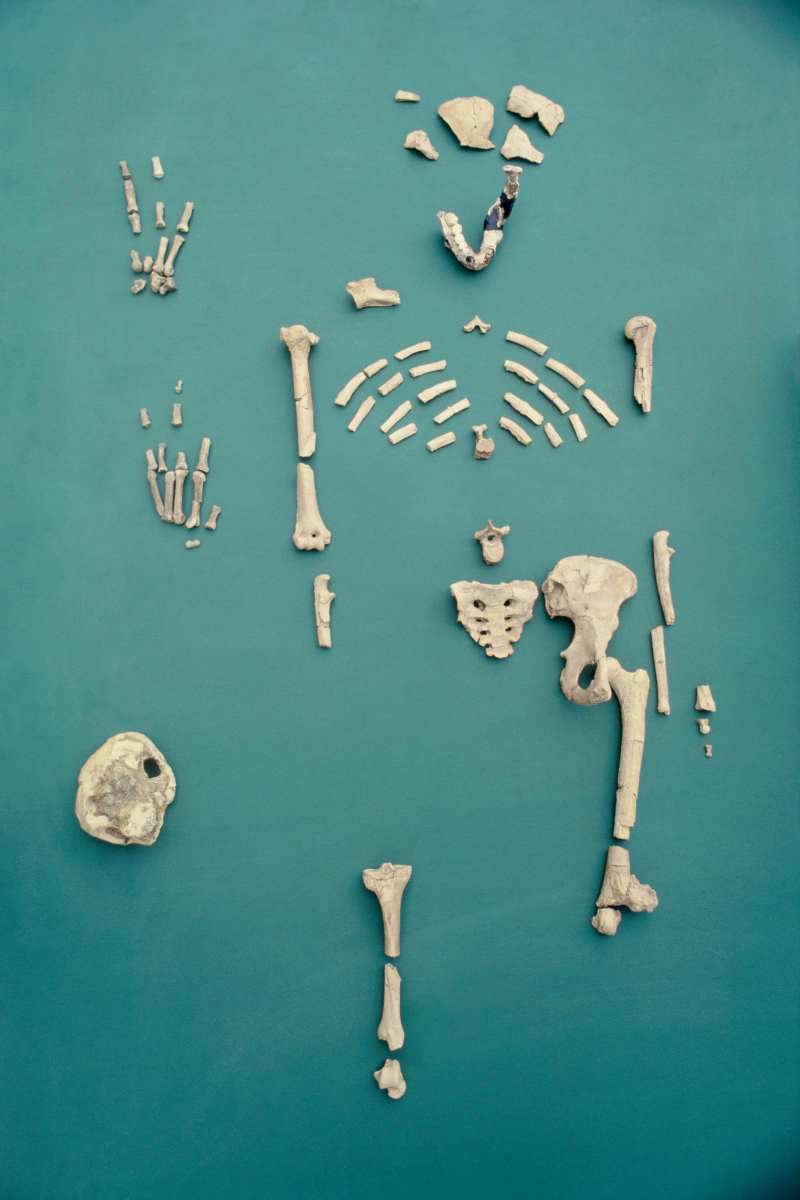
Credit: Alain Nogues/Sygma/Sygma via Getty Images
I find this all, well, marvelous. When I first read about these names, I found myself quite moved. Naming the mission after an ancient hominin was already a wonderful act by the Lucy team, connecting our past on Earth with the universe around us. Naming Dinkinesh shows respect for the Ethiopian people and their nation’s connection to our origins as humans.
This is scientists honoring not just what they study but also the humanity behind the science.
It’s in our nature to try to understand our origins; every culture has a creation myth. For scientists the origins of our planet and our species make irresistible puzzles, the pieces scattered across time and space, scarcity making them even more precious.
Along the way our nature also compels us to bestow names upon these things we study. It’s a lovely tradition, a way to memorialize events and people who have contributed to our history. This act has deep meaning to us. Just as we are driven to explore, these names help us as we seek connection with what we study. The way we create these relationships is more than a gesture; it reflects what we hold dear, an acknowledgement of what and whom we honor.
I am and always have been perplexed at the idea that scientists must always be distant, removed, dispassionate observers. Certainly when we analyze data that’s the default position, but that doesn’t mean it must always be so in every aspect of research— especially when it comes to studying our origins, both local and cosmic.
There is a profound joy to discovery, to the exploration of knowledge and to progress in pursuing truth. How can we not be in awe of this endeavor, and how can we not want to celebrate those who have helped us in this pursuit?
This is an opinion and analysis article, and the views expressed by the author or authors are not necessarily those of Scientific American.