
Illustration: © IoT For All
Artificial Intelligence (AI) and Machine Learning (ML) present a boon for businesses as technologies with the potential to help organizations make better predictions, create innovative services for customers, and deliver faster business outcomes. Finance teams, operations, customer success, and marketing departments stand to benefit. That said, the overarching reason that organizations are facing challenges and delays in bringing ML models into production stems from the fact that models are different from traditional software, and most organizations don’t yet have frameworks and processes for dealing with these differences. Let’s take a look at how a MLOps platform can help with efficiency and collaboration.
'Any MLOps platform should take a human-centered approach - meaning it is designed to provide users with the critical information they need' -Navin BudhirajaClick To Tweet
What is MLOps?
MLOps is a practice for a subset of the ML model life cycle to help teams deploy, manage, and maintain machine learning models and drive consistency and efficiency across an organization. Similar to DevOps—a set of practices that integrate software development with IT operations—MLOps adds automation to streamline the orchestration of steps in the workflow that begins once a model is ready to go into production.
A machine learning model’s life cycle spans many steps, and typically they are all managed by different people across discrete systems that need to be connected. These systems are used for data collection, data processing, feature engineering, data labeling, model building, training, optimizing, deploying, risk monitoring, and retraining. And in each organization, different people and teams may own one or more steps.
In an ideal environment, ML models are solving company problems and driving better decision analyses. However, only a fraction of these models enters production. Even then, it typically takes months for a successful model to become active, according to Gartner. That’s because the process of deploying a machine learning model into production is often disjointed. Siloed teams of data engineers, data scientists, IT ops professionals, auditors, business domain experts, and ML engineering teams operate in a patchwork arrangement that bogs down the process.
Downfalls of MLOps
Part of the problem is that MLOps is still an emerging discipline, and different people perform the tasks that span MLOps in each organization. In some organizations, data scientists are involved in nearly every step of a model’s life cycle; in others, there may be discrete teams for each phase or teams that own one or more areas. For organizations to realize the full value of ML, models need to be put into production quickly and at scale. There needs to be a guide for how to handle MLOps that makes sense for an enterprise’s goals and the structure of its team. Because of this, MLOps platforms are taking on an increasingly critical function in expediting the ML efforts of organizations.
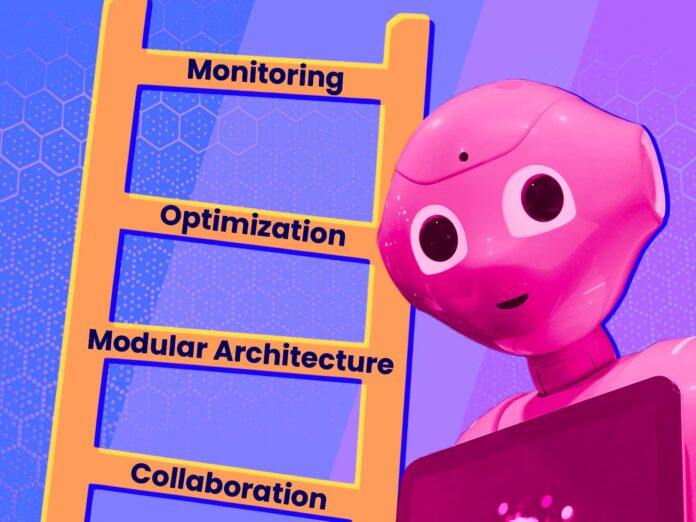
Platforms have the potential to deliver a blueprinted strategy to create repeatable and streamlined processes, regardless of whether the industry is manufacturing or financial services—or any other industry. End-to-end platforms can save an innumerable amount of time because of how many models can be deployed and monitored simultaneously while operating at the speed businesses need. The best MLOps platforms provide solutions for all ML stakeholders so they can not only deploy and manage models at scale but also foster efficiency through collaboration and communication across the different people using the platform at different stages. Let’s take a look at the four main aspects of a successful MLOps platform.
A Successful MLOps Platform
#1: A Collaborative Experience for all Stakeholders
Given that the key stakeholders—from data teams to engineers to risk auditors—tend to function in silos in many organizations, simplifying the process to enable any user to perform a specific role leads to better outcomes for efficiently performing tasks. Platforms that enable collaboration across an organization provide teams the ability to quickly operationalize models, regardless of the tools data scientists used to create those models. There is no longer a need to restrict any other user, such as machine learning engineers or IT teams. Each platform user should be able to use the tools they already have and leverage their expertise with those tools. Having a single, collaborative interface that can intuitively guide a user through the steps that abstract the complexity of the process is a beneficial component of MLOps.
#2: A User-First, Modular Architecture
Given that many organizations may be handling MLOps differently, platforms that meet them where they are offer immediate value. A platform with a modular architecture provides organizations the necessary flexibility to get up and run quickly by enabling each person to use the platform functionality that they need when they need it rather than forcing them to operate in a linear fashion.
For example, an organization may have data scientists with a preferred set of tools but who lack the ability to easily deploy or monitor models in production. An MLOps platform designed with openness and users in mind will offer easy plug-and-play components so each user can make decisions on the best cloud, database, repositories, and other components to use without having to make sweeping changes. Every company will implement the process of operationalizing models a bit differently, and modular architecture enables MLOps teams to leverage their entire suite of tools and seamlessly bring specific components of the platform into their ML workflows.
#3: An Emphasis on Optimization
As models become larger and increasingly more complex, one of the challenges organizations often run into is a dramatic increase in hardware or computing needs. Machine learning is, by definition, data-intensive and will cost organizations a lot of money without careful consideration of the infrastructure in place. Models that take a long time to head to production coupled with rising costs for hardware are a recipe for tension with executives and leadership weighing ROI in an organization.
MLOps platforms that can optimize models and present model performance and cost-saving data in a format that helps users make decisions based on the factors most important to them can alleviate some of the challenges organizations face as they ramp up ML modeling and production. As more companies deploy more ML models to more devices that can be on any cloud, edge devices, or on-prem, the ability to optimize models will become increasingly important.
#4: An Ability to Continuously Monitor Models in Production
It’s important for an MLOps platform to accelerate the process of bringing models to production. But once there, the real work begins, and platforms need to enable teams to continuously monitor risks, such as model performance and unstructured data, and quickly take action to mitigate operational and reputational risk.
ML models are not static. They are trained and tested in environments that are controlled, but when models are deployed into production they are making predictions based on real-world data which can be quite different for a variety of reasons. For example, a model’s performance or accuracy in predictions can change. Models also experience different types of drift, such as data drift, for when there is a significant change in buying patterns. This happened during COVID, for example, and led to former distribution patterns no longer being accurate.
Simplifying the Process
To help teams continuously monitor models in production, MLOps platforms should simplify the ability to:
1. Set alerts based on custom thresholds.
2. Provide quick at-a-glance access to key data points showing which models are failing.
3. Rapidly identify the root cause and take action.
Leveraging an integrated platform allows for the creation of a customized risk monitoring plan before and after deployment. A comprehensive approach to mitigating risk includes evaluating uncertainties within the data to guide AI/ML teams along the right path.
Platforms Must Put Humans First
We are still in the early stages of figuring out how to best use ML in enterprises. Any MLOps platform should take a human-centered approach—meaning it is designed to provide users with the critical information they need, an intuitive way to complete the tasks they need to complete, and the ability to collaborate and communicate with other stakeholders and colleagues. Platforms that put human workers first help build trust between people and ML. This garnered level of trust between person and machine helps ease the mind of the worker and allows the technology to perform many of the statistical tasks to aid these workers. The intentional design of such platforms will continue to focus on augmenting and amplifying human intelligence and delivering new opportunities to promote collaboration with advancing AI and ML initiatives.
- Artificial Intelligence
- Automation
- Data Analytics
- Data Scientist
- Machine Learning