
Sports are fun to watch and thrilling to play, but it’s difficult to judge. Given the fact that a ball can be disqualified by a quarter of an inch to disallow a goal because of a wrong pass, who is there to identify every minute issue in the gameplay? Referees are the most important segment of this industry as they are qualified to take the right decision. However, the integration of technology is challenging umpires and referees since their judgment can now be tested with the help of technology. As we are increasing the utilization of technology in these games, the results are now more accurate and analyzed. Right from training to gameplay, judgment, and post-match analysis, the applications of the technology are widespread. Let’s explore the potential of IoT technology in the sports industry.
“However, the integration of technology is challenging umpires and referees since their judgment can now be tested with the help of technology.“
IoT Is Changing the Sports Industry
The utilization of technology in sports is not a new phenomenon, but their marriage is bringing significant benefits to players, managers, and organizers. As the sports industry is adapting to the changes, IoT is here to speed up the digital transformation of every segment of a sports game. From how the fans engage with their favorite games to how the players train and play the game, IoT is game-changing for this industry. To completely understand the impact of IoT in this industry, we can look at it from three segments.
#1: Player Training
IoT-enabled smart wearables are assisting players in creating a bespoke training regimen. These training modules are prepared after analyzing the player’s strengths and weaknesses. With the help of wearable technology, the trainers and coaches can read crucial information, including muscle oxygen saturation (Smo2) and Subjective Rating of Perceived Exertion (sRPE).
Using this information and other parameters, the trainers can identify the Acute-to-Chronic Workload Ratio (ACWR). They can now better train the players and identify the fatigue loads. Even the more minute details, like the extension of muscle fibers and the exact moment of rest, are also shared through the right technology.
What this technology has done is helped trainers identify the difference between injury and intense training. IoT and Machine Learning algorithms are helping the teams build a safe training environment and schedule. Here, IoT systems are administered with sensors and advanced analytics software. Ultimately, they help build player efficiency and ultimately improve their performance.
In this segment, further classification reveals that players can get better training with the help of:
- Smart Apparels: Sensor-integrated clothes share real-time data to help improve player’s biomechanics and optimize training. With more precise information, players can get a better form, enhance their playing techniques, and even work on their timing.
- Smart Footwear: Advanced footwear is embedded with equipment like a gyroscope, accelerometer, and pressure sensors. These features help athletes and sportspersons train better and create a balanced training regimen. The core benefit of these features in sports training is not only optimized performance but also helps prevent injury.
Using IoT devices that are connected to the player’s footwear, we can gain crucial information about the player’s health. Wearing these shoes, the players can get crucial information and early detection of any condition that may inhibit their performance and capabilities.
In addition to these functions, IoT integration in player training is also seen in their equipment. From smart rackets to smart bails in cricket to smart football used in the latest edition of the FIFA World Cup, these elements are also observing a change. Sensors in the equipment measure and track how the players interact with their equipment and what can be done to improve the same.
For instance, IoT-enabled sensors in a racket can note down the number of forehands, serves, overhead shorts, backhands, etc. In addition to this, they observe and record which shots are hit well and what’s the optimal position for holding the racket. A visually understandable picture is painted with the help of IoT, which trainers and coaches can use to formulate an efficient training schedule.
#2: Gameplay
During the game, IoT and its sensors play an integral role in helping referees and umpires make the right decisions. The FIFA 2022 World Cup football was embedded with sensors to measure the minute aspects of the gameplay.
In cricket, there are infrared sensors, and proximity sensors, among other equipment, to help the umpires make the right decisions. Sensors are embedded into cricket bats to exactly locate the ball’s impact location. The software at the backend uses algorithms to analyze the bat’s power relayed to make the shot.
Here, the main focus is collecting data about the player’s actions and performances. Coaches monitor, track, and analyze this data to provide performance improvement strategies. For a more precise analysis of the gameplay in Football, VAR is used. VAR has IoT smart cameras. The purpose is to get a more accurate and precise analysis of the goal line. As a result, the players and fans will have more confidence in the in-game decisions.
IoT-enabled cameras and recording make viewing a sports game more interesting. The mix of different angles and perspectives allows the viewers sitting at home and in the stadium to watch every move of the player with complete detail.
#3: Operations
Operational aspects of sports include integrating IoT into the management aspects. The result is smart stadiums and better fan engagement. The key here is to use data and information to customize the fan’s experience. IoT has made it possible to build state-of-the-art stadiums, giving a more immersive experience to the spectators. The FIFA World Cup 2022 has become the best example of how IoT can be integrated to increase the fan’s accessibility within the tournament.
A single application dedicated to the world cup helped the fans plan their entire stay and visit to the country. From planning their movements in and around the stadium to exploring the nearby attractions to getting real-time information about the weather, match, and other details, it’s an all-in-one app.
Another big move in this area is coming with the Paris Olympics yet to happen in 2024. Here, the Olympic City will showcase a great example of the future smart cities.
Moving forward, using the same technology, building smart stadiums also includes giving sitting and parking information to the fans. Given the precautionary environment required after the pandemic, smart sensors can help monitor body temperature and maintain the stadium’s air quality.
Interesting IoT Use Cases in Sports
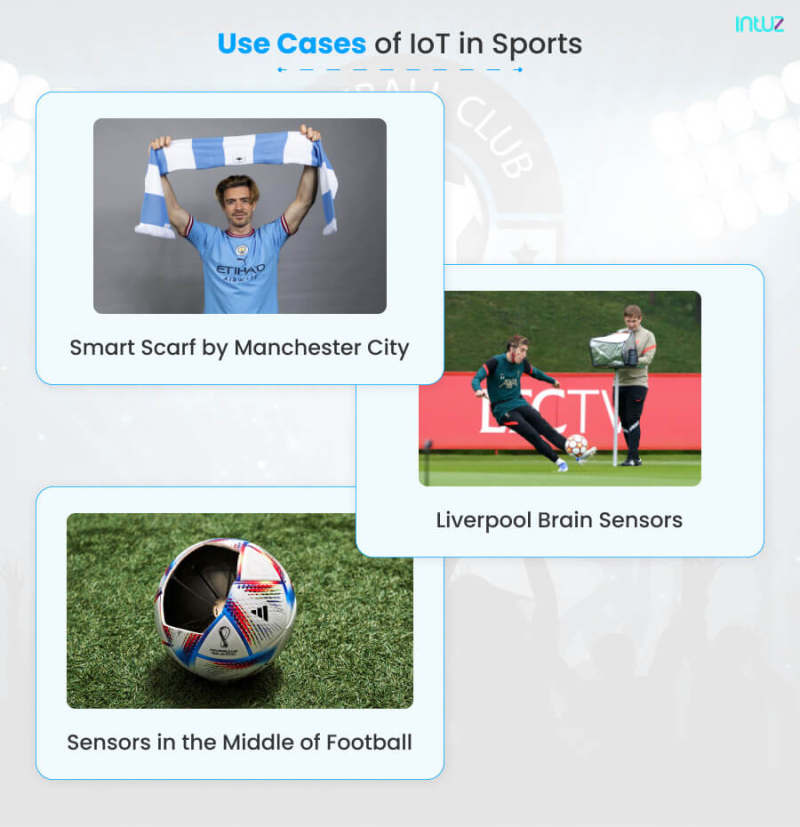
Teams, clubs, and management are using IoT in unique ways to improve how they train players, how fans interact with the games, and much more. Here are a few examples of some popular sports franchises:
- Smart Scarf by Manchester City: To make the fans feel more alive during the game, Manchester City created a connected scarf embedded with EmotiBit. This sensor tracks the body temperature, heart rate, and emotional state of the individual wearing the scarf. As a result, the fans will feel more connected to the game than ever before. The scarf will allow the organizers to view closely how each fan feels during the game.
- Liverpool Brain Sensors: Liverpool players are seen wearing brain sensors to fine-tune their mental capacity and play a better game. While Liverpool players used these sensors before their 2020 Premier League tournament. The motive is to help the players perform at their best.
- Sensors in the Middle of Football: The FIFA World Cup football is embedded with two sensors. These are the ultra-wideband sensors and inertial measurement unit sensors. These sensors deliver precise positional and movement information about the ball.
A Perfect Match
IoT and the sports industry are a perfect match and are made for each other. The way IoT has impressive applications in every segment of the sports industry leaves a lot of room for further innovation. The inclusion of this technology is not only about generating more revenue but also about improving the overall dynamics of the industry.
Tweet
Share
Share
- Connectivity
- Data Analytics
- Medical Devices
- Remote Management
- Wearables
- Connectivity
- Data Analytics
- Medical Devices
- Remote Management
- Wearables