
Gigabit LTE: The 4G Solution for High-Speed Cellular Broadband
5G receives much attention as it has become table stakes for consumers. Gigabit LTE, the 4G technology that introduced no-pause streaming video on our smartphones, is its lesser-known precursor. It’s an evolution of 4G LTE that can provide dependable mobile broadband access at speeds surpassing wired broadband.
Coverage is improving fast as carriers roll out 5G at breakneck speed. However, Gigabit LTE remains available with nationwide coverage worldwide. 5G is a recent technology with new radio waveforms and new modems. Therefore, the price of 5G will be higher than 4G products for some time.
The cost of the new 5G chipsets will include a price premium because of all the new features in the devices. On the other hand, 4G device prices will decrease as they achieve an economy of scale with large deployments.
Gigabit LTE vs. 4G LTE
A greater focus on data transmission came with the fourth-generation mobile communication standard (4G). Previous cellular standard generations (2G and 3G) centered on voice and text capabilities, catering to pre-smartphone consumers.
For smartphones and mobile broadband communication, the LTE-Advanced (LTE-A) standard was approved in 2011 (3GPP Release 10). It delivered peak download data rates of 1 Gbps.
LTE-Advanced Pro (LTE-A Pro) enhanced Gigabit LTE capabilities. 3GPP approved this standard circa 2015 with Release (Rel) 13. LTE-A Pro took 4G a step further. It provided peak download speeds into the 3 Gbps range, depending on networks’ availability of high carrier aggregation (up to 32 20-MHz carriers allowed in LTE-A Pro).
Key 5G technologies and strategies enable LTE-A Pro to prove the robustness and resilience of these ultrahigh-speed connections. The connection speed can be faster than wired broadband. Those include:
Carrier Aggregation
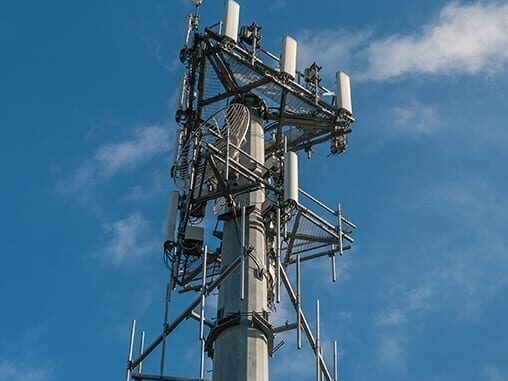
Mobile network operators (MNOs) can provide increased data speeds. They combine the data-carrying capabilities from multiple sections of the radio spectrum, known as “carriers,” to send and receive data.
Carrier aggregation combines an MNO’s often non-contiguous carriers within one or more spectrum bands. It expands data pathway width and carrying capacity to allow for higher capacity and speeds. Gigabit LTE requires five or more carriers aggregated to push theoretical data rates to peak at levels higher than 3 Gbps.
With 5G taking more spectrum share, the industry trend will eventually migrate all devices to 5G. However, that will take more than a decade to happen. Until then, LTE will fill the gap for mid-tier devices.
With 3xCA, LTE devices will get decent speeds for many broadband use cases. In addition, high-tier devices that require multigigabit speeds will eventually migrate to 5G.
License Assisted Access (LAA)
To increase data-carrying radio spectrum capacity, LAA uses the unlicensed 5 GHz band in conjunction with the MNO’s licensed spectrum. Licensed spectrum is known as “cleared spectrum.” Nobody other than the licensee is using that spectrum within the regional boundaries of the license.
Unlicensed spectrum is available for various uses like Wi-Fi, which also functions within the 5 GHz band. LAA must work around these other users to apply techniques like Listen-Before-Talk (LBT) function to identify and utilize unused channels.
256-QAM
Quadrature Amplitude Modulation (QAM) is an efficient two-domain encoding strategy. It leverages amplitude and frequency modulations to encode information in the radio waveforms. The higher the QAM number, the more information the waveforms can carry.
Before 256-QAM, there was 64-QAM. When 64-QAM is used, 6 bits of information can be in each encoded symbol, so 2^6 equals 64. In 256-QAM, 8 bits of data can be packed in the same symbol, so 2^8 equals 256. 256-QAM bit rates are 30% faster than 64-QAM bit rates.
This increased data rate means 256-QAM requires a better signal-to-noise ratio (SNR) than 64-QAM. So when a radio is in good reception and gets a strong signal, it can perform 30% better than the older system based on 64-QAM.
4 x 4 Multiple-Input and Multiple-Output (MIMO) Technology
As carrier aggregation achieves higher bandwidths with multiple carriers, so does MIMO with multiple antenna paths per band. Gigabit LTE networks have standardized four antennas on the base station and four on the device. These antennas improve spectral efficiency and data speeds, allowing the equipment to connect with the steadiest available signals.
Gigabit LTE vs. 5G

While Gigabit LTE and 5G are similar, a few key details set them apart. 5G adds new bands in available frequencies in the sub-6 GHz range and ultrahigh millimeter wave (mmWave) spectrum (up to 40 GHz). 4G is mostly deployed in the lower frequencies (up to 2.5 GHz) except for a few bands in 3.5 GHz (also called mid-band).
Furthermore, 4G spectrum is limited to a maximum bandwidth of 20 MHz. This means each 4G carrier’s capacity is limited to 20 MHz. On the other hand, 5G defines new spectrum bands that are 100 MHz wide. We can imagine how aggregating a few carriers can achieve high speeds in 5G.
Since bandwidth-rich mmWave cells cover small areas, dense concentrations are necessary to achieve target user experience levels. A 5G experience significantly different from Gigabit LTE requires constructing new infrastructure, which will take time.
Another differentiator is that 5G networks can work in two modes: stand-alone (SA) or non-stand-alone (NSA). SA indicates that the system operates with all 5G radio and core networks. NSA uses LTE and 5G resources combined in different modes.
With 3GPP Rel 16 published in 2020, 5G became a solid alternative to wired networks used in critical industrial processes. These processes are dominated by various wire and fiber-based time-sensitive networks (TSN). Rel 16’s ultrareliable low latency communication (URLLC) capabilities specify link reliability better than 99.9999% and latencies in the millisecond range.
Applications and Use Cases of Gigabit LTE Networks
Gigabit LTE’s broad availability and falling connectivity costs offer the advantage of easier adoption. Unlike 5G, it doesn’t require constructing new towers or redesigning device antennas to cope with mmWave or URLLC technologies’ demands. Gigabit LTE offers many of the benefits associated with 5G (e.g., high-speed data) without design challenges for businesses worldwide.
Here are a few ideal use cases for Gigabit LTE:
Remote Locations
Businesses and agencies must often add network connectivity to sites and venues out of the existing infrastructure’s reach. Wired connections using copper or fiber can be extremely expensive and require long installation lead times. Deploying a cellular router to deliver Gigabit LTE broadband access to these sites is more cost-effective. In cases like natural disasters and pop-up events, it’s the only available option.
Industrial Applications
There are several industrial applications in which Gigabit LTE is crucial (e.g., security applications requiring high bandwidth). If a company needs to monitor remote locations with video cameras streaming 24/7, Gigabit LTE is the most reliable method.
High-definition (HD) and ultrahigh-definition (UHD) cameras and those used in surveillance and industrial applications require high bandwidth on the uplink. However, not all Gigabit LTE modules will deliver the full specification. Gigabit LTE modules must implement two radio chains on the uplink side to provide interband carrier aggregation. Otherwise, the device will only benefit from half the network’s capacity.
Branch Offices or New Stores
Gigabit LTE provides an inexpensive, efficient solution for companies that must set up internet connections at branch offices or temporary stores. It requires minimal setup: The operator switches on an LTE router and provides connectivity in minutes.
Failover Access to Reduce Downtime
Even if an office maintains a wired connection to the internet and head office, Gigabit LTE can be a backup system. Downtime can be expensive, costing a small business about $423 per minute and large companies around $9,000 per minute. A Gigabit LTE backup system costs very little by comparison and provides insurance against such losses.
As we await denser coverage of 5G, Gigabit LTE offers an accessible and efficient solution today.
Speak with our IoT experts today to request a project review or developer kit.
Request a Developer Kit
Editor’s Note: This blog was originally published on 29 April 2020 and has since been updated.