


Artificial Intelligence (AI) is revolutionizing how marketers and customer-facing business areas are interacting and engaging with customers. In fact, in today’s fiercely competitive world, data science is helping rewrite the dynamics of the business, as it enables precision in the personalization of the customer journey, which was not possible before. Today, every company’s future is inexorably tied to the journey of its customers. Studies have shown that 88 percent of U.S. marketers reported seeing measurable improvements due to personalization, and 44 percent of consumers said they would become repeat buyers after a personalized shopping experience with a company. What’s more, businesses saw an average increase of 20 percent in sales when using personalized AI experiences.
In fact, customer personalization does not end at selling a product or service to a customer. It has to extend beyond. Highly personalized customer service can help a brand exceed customer expectations resulting in a higher Net Promoter Score (NPS). This will help reduce churn and upsell/cross-sell opportunities. For personalization to be effective, it requires a systemic and sustained effort and the involvement of all of the team members. Investment in data, tech, and people is required to make it a success.
“For personalization to be effective, it requires a systemic and sustained effort and the involvement of all of the team members.”
-DAIN Studios
How AI Can Help
Personalization AI can help businesses improve the customer experience, increase sales and revenue, and improve their marketing efforts. We recommend you focus on four major initiatives for the deployment of AI and data science to personalization:
#1: Customer Onboarding
By setting the customers up for long-term use of your product or service from the initial stages with the help of algorithms, you can increase retention rate, boosting referrals and reducing abandonment rate.
#2: Next-Best-Action Calculation
By using a dynamic decision strategy that uses all customer data to find the best next action for (potential) customers, you can increase customers’ satisfaction which will lead to higher conversion rates and revenues.
#3: Cross-Sell and Upsell of Products/Services
By recommending products or services that are tailored to a user’s interests, you can increase the likelihood that a user will make a purchase, which will lead to an increase in revenue.
#4: Churn Prediction & Prevention
Based on a dynamic calculation of the percentage of dropped-out customers within a predefined time interval and deploying prevention strategies to prevent churn, you can ensure a long-term relationship with the customer and revenues.
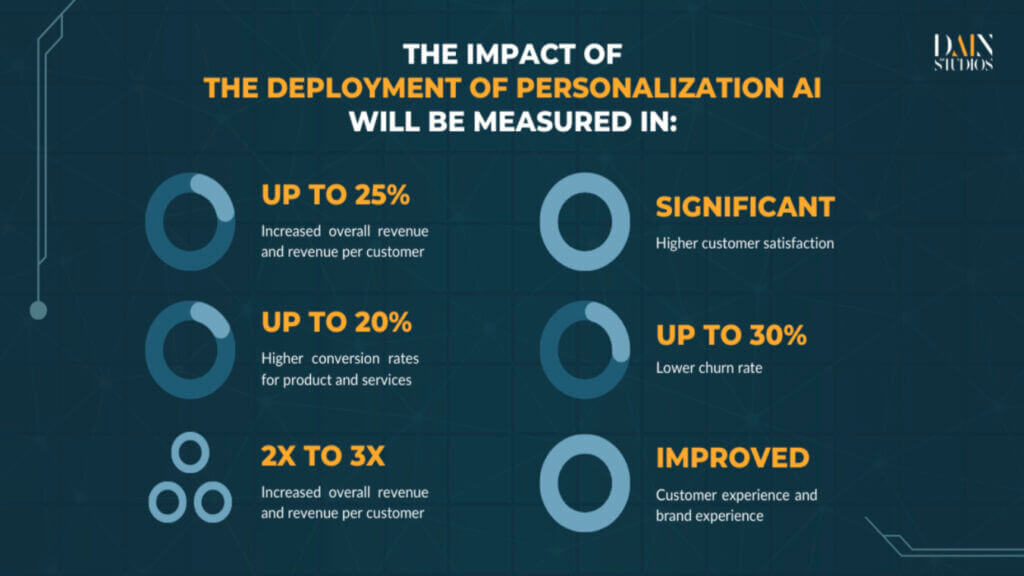
The impact of the deployment of personalization AI can be measured in the:
- Increased overall revenue and revenue per customer – by up to 25 percent.
- Higher conversion rates for products and services – by up to 20 percent.
- Higher ROI for marketing Investments – 2x to 3x.
- Higher customer satisfaction – significant.
- Lower churn rate – by up to 30 percent.
- Improved customer experience and brand experience.
*Please note that the benchmarks and numbers mentioned in the article are based on internal research and clients projects of DAIN Studios.
Industries that Benefit from Personalization AI
While Personalization AI can be beneficial to a wide range of industries, including e-commerce, manufacturing of consumer and industrial goods, retail, finance, healthcare, and more, specific applications will vary depending on the needs and goals of the individual business.
For example, manufacturers and retailer can engage in a direct-to-consumer interaction and use AI to understand customer needs, recommend the products based on their browsing and purchase history, and hence increase the overall basket value.
In the healthcare industry, personalization AI can be used to provide personalized service, such as by providing information or assistance that is tailored to a customer’s needs. In the finance industry, personalization AI can be used to provide personalized financial advice and recommendations, such as by analyzing a customer’s financial history and providing advice on investment or savings options.
Getting Started
Getting started with the Personalization AI journey means getting the business ready to become data-driven. While all of the following steps will be important, without data, none of it will work.
Getting the data to be able to build machine-learning models means centralizing and activating the data. Centralizing data will help get all the data in a high-quality manner into one location, like a CDP. Activating the data means acting on the outputs of the machine-learning model to derive real, tangible value for the customer and business. There are also a number of activities that the business needs to focus on:
- Identify the specific goals and objectives that the company hopes to achieve with personalization AI. This can include goals such as improving the customer experience, increasing sales and revenue, or improving marketing efforts.
- Collect and activate data about the company’s customers. This can include data about their preferences, behavior, and interests. This data can be used to train the personalization AI and to provide personalized experiences for individual customers.
- Select and implement a personalization AI platform that is suitable for the company’s needs and goals. Specific platforms or tools will depend on the company’s needs and goals while integrating the personalization AI with the company’s existing systems and processes, such as customer relationship management (CRM) systems or marketing automation tools will be the key to success.
- Monitor and evaluate the performance of the personalization AI to ensure that it is achieving the desired goals and objectives. This can involve tracking key metrics, such as customer satisfaction or sales revenue, and making adjustments as necessary to improve the performance of the personalization AI.
Making the Impossible Possible
Overall, the real benefit of using AI and machine learning in marketing, sales, and customer care for the personalization of customer engagement, is making the impossible possible: being faster in calculating the best outcomes within a complex environment, detecting patterns, and optimizing granular behavior which would be invisible for the human eye. Personalization AI is a game-changer and a competitive necessity for any business nowadays.
Tweet
Share
Share
- Artificial Intelligence
- Artificial Intelligence
- IoT Business Strategy